Medical Law and Ethics Chapter 8 Review Questions
Affiliate 8 – Ethical and Legal Considerations
Previously we discussed the personal attributes that will help you succeed on the job. At that place are too standards for conducting your professional work ethically and legally that must be understood and heeded. Missteps in these areas will undermine not only your own credibility merely tin take broad-ranging repercussions for the system and profession within which you work.
Following is a discussion of the levels of responsibility that affect the data you get together and utilize, and the messages you create. In one case you empathise the constraints you must acknowledge in your work equally a message creator, y'all'll be able to think strategically nearly the information yous need to create that consequence. Having this foundation will also help you evaluate the ceremoniousness of the information you notice.
Existence a socially responsible communicator requires attention to both ethical standards and legal requirements. Commencement, we need to draw a distinction between ideals and law.
Distinction Between Ethics and Police force

Ethics
- A co-operative of philosophy
- Deals with values relating to man conduct
- Concerned with "rightness" and "wrongness" of deportment
- Self-legislated and self-enforced
- Sometimes difficult to determine because of competing, equally-valid possible choices
Law
- Derived from ethical values in a society
- Formally / institutionally determined and enforced through courts and law enforcement officials
- Easily determined because information technology is a matter of statute and the legality of activity and consequences for not adhering to the police is spelled out
In the previous lessons on developing your information task list and determining questions to answer, we've focused on specific information-seeking goals. In each of the communication professions, there are key legal considerations that must be understood that will either help or hinder, the seeking of information to encounter those goals.
In news, for case, if some of the information needed requires the utilise of public records and then an understanding of public records and privacy laws will help you know what it is possible to become, and how to legally use these records.
In advertising, you might want to make the most of the attributes of the production you are promoting, but you lot volition demand to bide by laws dictating the substantiation of production claims.
For public relations professionals, y'all may need to issue a corporate response to a crunch, therefore information technology is of import to empathise the requirements or restrictions of corporate disclosure laws. We will hash out these legal perspectives later in this lesson.
Socially responsible communicators are non content with just staying on the right side of the law. While the constabulary embodies a significant portion of our values, individuals and organizations that desire to be considered socially responsible must become across the rough requirements of the law itself and adopt higher and more than thoughtful standards.
In some cases, these standards may have a legal basis as well every bit an ethical one. Post-obit these standards requires the communicator to consider both "positive obligations" (things that y'all must ever strive to do) or "negative obligations" (things that you must baby-sit against doing).
Let's look at the positive and negative obligations that utilize to those crafting news messages. These are fatigued from the Code of Ethics of the Society of Professional person Journalists, a long-standing professional person clan for news professionals.

Positive Obligations(goals you try e'er to achieve)
1) Seek truth and study it. This requires that yous:
a. examination the accuracy of information from all sources.
b. fairly represent multiple perspectives and viewpoints.
c. identify sources whenever feasible so the public may estimate the reliability of the information.
d. safeguard the public's demand for information.
Despite the rhetoric of First Amendment attorneys, the public does not have a "right to know" per se. The First Subpoena to the Constitution of the United States says that citizens take a right to assemble, speak, practice their chosen religion, petition the government for a redress of grievances, and that the Congress shall brand no police limiting the liberty of the press. It does not address the public's "correct to know" anything. Just most communication scholars acknowledge the crucial role that the media play in nurturing an informed electorate and citizenry.
two) Minimize harm. This requires that yous:
a. avoid privacy violations. Only an overriding public need can justify intrusion into anyone'southward privacy and such intrusion may invoke legal sanctions if a source can demonstrate harm. In the context of information seeking, information that can exist establish should not necessarily exist used.
b. be cautious nigh naming criminals earlier the formal filing of charges, identifying juvenile suspects or victims, or seeking interviews or photographs of those afflicted by tragedy or grief.
3) Act independently. This requires that you:
a. be wary of sources offer information for favors or money.
b. disclose potential conflicts of interest. IE: declining to label the content from a video news release in a Television set circulate story is a breach of ethics.
c. concur those with ability accountable.
4) Be accountable . This requires that you:
a. admit mistakes and correct them promptly. Libel law may exist invoked if the mistake injures a news subject field.
b. stand upwardly for what is right in the media organisation.
c. abide by the same high standards to which you hold others.
Negative Obligations: (deportment that must be avoided)
1) Plagiarism . Never, ever, always represent someone else's work as your ain. Never. Ever.
2) Concealing conflicts of interest, real or perceived, in seeking or using information. If you take a stake in the outcome of what you are reporting on, y'all must acknowledge it and perhaps suggest that someone else embrace the story.
iii) Distorting the content of news photos or video. Image enhancement for technical clarity is permissible, but any other blazon of manipulation must not happen.
four) Eavesdropping. Listening in on others' conversations, electronically or otherwise, is a class of information-stealing and may invoke wiretapping laws or other legal sanctions.
five) Breaking the "contract" with a source. Publicly identifying a source who provided information confidentially, for instance, is both an upstanding and a legal violation. Nosotros will discuss the details of the source contract in lesson ix on interviewing.
These are a sample of the negative and positive obligations that help you counterbalance your decisions when a situation arises in your data gathering for a news bulletin.
Ethical thinking requires that you establish for yourself, ahead of time, how you value these various obligations and which take precedence in your own scheme of decision-making. You lot also must exist fully aware of how your media organization has ordered these priorities for their ain publications, and comply with the standards that your organization has established.
Simply as in news, advertising professionals adhere to a number of constraints when gathering and using information, regardless of the blazon of ad they may be creating. We can once again understand these in the context of positive and negative obligations. These are drawn from the principles and practices of the Constitute for Advertising Ethics.
Positive Obligations
1) Create letters with the objective of truth and high ethical standards in serving the public. Advertising is commercial information that must exist treated with the aforementioned accuracy standards as news and there may be legal repercussions if the standards are not upheld.
2) Apply personal ethics, like being an honest person, in the creation and dissemination of commercial information to consumers.
3) Clearly distinguish advertising from news and editorial content and entertainment, both online and offline.
4) Conspicuously disclose all material atmospheric condition, such every bit payment or a gratis product, that affects endorsements in social media and traditional message channels. This is both an upstanding and a legal requirement, enforced past the Federal Trade Committee and other regulatory bodies. For case, a blogger who is paid past a company to spread positive information about the company's production or service must disembalm she being paid for her opinions
5) Treat consumers fairly, especially when ads are directed at audiences such equally children. In fact, the legal requirements for advertising aimed at children are increasingly stringent.
6) Follow all federal, country and local advertising laws, and cooperate with industry self-regulatory programs for the resolution of complaints.
7) Stand for what is right within the organization. Members of the squad creating ads should limited their upstanding or legal concerns when they arise. This is a adept example of the personal ethics that must gene in decision-making in creating letters.
Negative Obligations
These are obligations that represent both an upstanding and, in most cases, a legal/regulatory element. The National Advert Division of the Quango of Better Business Bureaus, the National Advertising Review Board, the Federal Merchandise Commission, the Federal Nutrient and Drug Administration and many other bodies enforce these obligations when necessary.
1) Do not plagiarize. Never, ever, always correspond someone else'southward work as your own.
2) Do not use imitation or misleading visual or exact statements.
3) Practise not brand misleading price claims.
four) Do not make unfair comparisons with a competitive production or service.
5) Do not brand insufficiently supported claims.
6) Do not use offensive statements, suggestions or pictures.
7) Do not compromise consumers' personal privacy, and their choices as to whether to participate in providing personal information should be transparent and easily made.
Allow'south await at the positive and negative obligations that aid PR specialists gather and use information responsibly. These examples come from thePublic Relations Order of America Fellow member Lawmaking of Ethics.[one] In one case once more, many of these obligations refer to both ethical and legal responsibilities.
Positive Obligations
1) Serve the public involvement by acting equally responsible advocates for those the PR business firm or professional represents.
two) Adhere to the highest standards of truth and accurateness while advancing the interests of those the PR firm or professional represents.

three) Acquire and responsibly apply specialized knowledge and feel in preparing public relations letters to build mutual understanding, credibility, and relationships amidst a broad array of institutions and audiences.
4) Provide objective counsel to those the PR firm or professional represents. For example, the best advice for a client may be to acknowledge wrongdoing and apologize. The PR practitioner must objectively weigh this advice and offer it if it is the best pick.
5) Deal fairly with clients, employers, competitors, peers, vendors, the media and the general public.
6) Act promptly to right erroneous communication for which the PR firm or professional is responsible. Again, failure to do this could invoke both upstanding and legal sanctions.
Negative Obligations
1) Do not plagiarize. Never, e'er, ever represent someone else's piece of work as your own.
2) Practise not give or receive gifts of any type from clients or sources that might influence the information in a message beyond the legal limits and/or in violation of government reporting requirements.
iii) Do not violate intellectual property rights in the market. Sharing competitive information, leaking proprietary information, taking confidential information from 1 employer to another and other such practices are both legal and upstanding violations.
4) Do non employ deceptive practices. Request someone to pose as a "volunteer" to speak at public hearings or participate in a "grass roots" campaign is deceptive, for instance.
5) Avoid conflicts of interest, real or perceived. PR professionals and firms must encourage clients and customers equally well as colleagues in the profession to notify all affected parties when a conflict of interest arises.
You can see from the sampling of positive and negative obligations that as a communications professional yous must weigh a wide variety of considerations when gathering and using the information to create a message. The intended audition, the purpose of the message, the intent of the communicator, the ethical considerations, the legal constraints, and many other variables help determine how y'all pursue the information strategy.
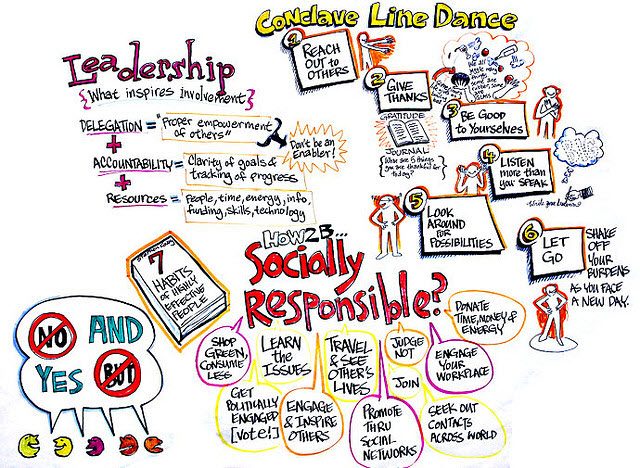
As a communications professional you must also conduct your work in the context of a commitment to social responsibility at a number of levels. Because mass communication messages are pervasive and influential, media organizations and professionals are held to loftier standards for their actions. The social responsibility perspective helps outline how this works.
There are three levels of responsibility that touch on your work as a communicator. These are:
- Societal : the relationships between media systems and other major institutions in order.
- Professional / Organizational 50:your profession's and your media system's own cocky-regulation and standards for professional deport.
- Individual : the responsibility yous have to society, to your profession, to your audience and to yourself.
We'll examine each of these in turn.
The societal perspective examines how media institutions interact with other major institutions in society. As a communications professional, it is important to empathise the societal implications of your work and the rules under which you operate.
Professional education and licensing have been traditional means by which lodge has sought to ensure legal and ethical behaviour from those who bear important social responsibilities. For constabulary, medicine, bookkeeping, didactics, architecture, engineering and other fields of expertise, specific preparation is followed past examinations, state licensing and administration of oaths that include promises to live up to the standards established for the profession.
However, in that location is no U.S. police force that requires communicators to be licensed. Without the power to control entry into the field and withdraw the license to operate every bit in these other professions, it is fifty-fifty more important for mass communication professionals to police force themselves. Specially in low-cal of the huge explosion of "fake news" being generated past individuals with political, cultural or financial motives, legitimate news professionals must defend their crucial office in society.
Allow's await at examples of the way the media interact with other major social institutions. Ane of the major tenets of journalism is the goal of exposing public officials or business concern executives to public scrutiny. This "watchdog" role, ane of the near important functions of the press, is used to justify journalists' behaviour in investigating what public officials or corporate executives are doing and whether or not they are meeting their responsibilities to constituents, citizens or shareholders. The First Amendment protects journalists' rights to claiming authorities ability.
Yet, serious observers fence that when overly aggressive investigative techniques expose individual politicians or corporate executives to scrutiny about their private lives that may have nothing to practice with the performance of their official duties, information technology causes cynicism, it undermines public confidence in major social institutions, and it drives people abroad from participation in public and civic engagement. How far does the "watchdog" role get? When is a journalist crossing the line from examining public behaviour to voyeurism well-nigh private lives?
Similarly, strategic communications professionals confront questions about their interactions with other major social institutions. There is more and more than agitation for government regulation of ad because people perceive that advertisers do not law themselves plenty.

In 2012, the Federal Trade Commission imposed the largest fine in its history on the visitor that manufactures Skechers athletic shoes and dress. The company paid $twoscore million because its ads falsely represented clinical studies backing up claims that Shape-Ups, Resistance Runner, Toners, and Tone-Ups would help people lose weight, and strengthen and tone their gluteal, leg and intestinal muscles. The ads used lines such as "Shape up while you lot walk," and "Get in shape without setting foot in a gym." Equally role of the settlement, Skechers had to have down the advertising and inform retailers to remove the deceptive claims. It likewise agreed to stop misrepresenting whatever tests, studies, or inquiry results regarding toning shoes. And customers who purchased the shoes or dress were able to file through the FTC for a refund from the company.[ii]
The example points out the interactions between advertisers, government regulators and the public at the societal level.
Some other example points out the social responsibility interactions betwixt advertisers, corporations and the customers they serve effectually the sensitive issue of personal privacy.
The social network Facebook, used past 900 million people worldwide, agreed in June 2012 to pay $20 million to settle a lawsuit in California that claimed Facebook publicized that some of its users had "liked" sure advertisers merely didn't pay the users, or give them a way to opt-out.
The so-called "Sponsored Story" feature on Facebook was essentially an advertisement that appeared on the site and included a member's Facebook page and generally consisted of another friend's name, profile film and a statement that the person "likes" that advertiser. The adjust was one in a long listing of complaints against the social media giant and other online organizations such as Google that appear to be working with advertisers to intrude on consumers' privacy.[3]
A group of digital advertising merchandise organizations called the Digital Advertising Brotherhood is concerned enough near advertisers' interaction with consumers, engineering science companies,

privacy advocates and federal/state regulators that information technology has created a fashion for people to opt out of having their online behaviour tracked. A turquoise triangle that appears in the upper right-hand corner of banner ads on spider web sites allows users who click on it to remove themselves from having personalized advertizement directed at them.
The group created the option in reaction to pressure from other institutions, including the Federal Merchandise Commission, which is threatening to regulate mobile and digital privacy and exert more control over children's privacy online. The example points out how diverse societal-level institutions interact to impose social responsibleness on media practitioners if they do not regulate themselves.
As strategic communicators have adopted social media platforms to distribute their letters, scrutiny past other societal institutions has increased. The Federal Trade Committee was so concerned most claims existence made by advertisers and PR practitioners via social media that they updated their social media guidelines in 2013.
The new FTC guidelines require social media marketers to:
- fully disembalm their sponsorship of the information. If an advertiser has hired a blogger to endorse a product or service, the blogger MUST disclose that he or she is working for that advertiser; if a PR firm posts positive comments well-nigh its clients on social media, the house MUST disclose that they are working on behalf of the client. Further, the disclosure must be clear and conspicuous; it cannot exist buried in the fine impress.
- monitor the social media conversation and correct misstatements or problematic claims by commenters.
- create social media policies to instruct employees virtually the expectations and practices that will be enforced.
The mention of company-specific social media policies leads us to the next category of responsibility: the professional or organizational perspective.
In addition to the societal level of interactions, communication organizations and professionals appoint in self-criticism and set standards for their own conduct and performance as information gatherers. One of the most conspicuous examples of this lies in the proliferation of codes of deport for mass communication activities at all levels. As our discussion of positive and negative obligations (above) demonstrated, every mass communication industry develops these professional person and organizational guidelines for its practitioners.
In the news industries, codes take expanded in number and scope over several decades. Organizations that take adopted such codes include the American Society of News Editors, the Society of Professional Journalists, the Associated Press Managing Editors Clan, the Radio Boob tube Digital News Association, and the National Press Photographers Association. Private news organizations and publications frequently establish their own codes to which they expect their staff to attach.
Ad codes reverberate some of the specific criticism directed at the field, such as charges of deceptive advertising, unfair stereotyping, false testimonials, and misleading claims. Organizations as diverse every bit the Discussion-of-Rima oris Marketing Clan, the Children'south Food and Drink Advertising Initiative, the Pharmaceutical Inquiry and Manufacturers of America and the Beer Institute have guidelines and codes for the content and placement of advertisements in their respective industries or for the audiences with which they are concerned.
For case, here is a portion of the Advertizement and Marketing Code for the Beer Institute. Any advertising professional working with a client who sells and advertises beer would need to attach to this industry code.
"Brewers should employ the perspective of the reasonable adult consumer of legal drinking age in advertising and marketing their products, and should be guided by the following bones principles, which have long been reflected in the policies of the brewing industry and continue to underlie this Code:
- Beer advertising should non suggest direct or indirectly that any of the laws applicable to the sale and consumption of beer should not be complied with.
- Brewers should adhere to contemporary standards of skillful taste applicable to all commercial advertisement and consistent with the medium or context in which the advertising appears.
- Advertising themes, creative aspects, and placements should reflect the fact that Brewers are responsible corporate citizens.
- Brewers strongly oppose corruption or inappropriate consumption of their products."[iv]
Individual ad agencies and corporate advertising departments too have codes and standards to help employees recognize and bargain with upstanding questions.
Nigh media outlets have or pass up ads submitted to them using a set of guidelines virtually what types of ads are acceptable and what type of content they volition allow.
For example, here is a portion of the policy for credence of advertising that appears in Texas Parks and Wild fauna Mag
- All advertisements are field of study to the approval of the Texas Parks & Wild fauna Department (Publisher), which reserves the correct to reject or cancel any ad at any time if the advertisement does not conform to the editorial or graphic standards of the magazine as determined by the Publisher.
- Advertisements that are not appropriate for viewing past youth will not be accepted. Advertisements will non be accepted for tobacco or alcohol products. (Tex. Parks & Wild. Lawmaking §11.172(c); 31 Tex. Admin. Code §51.72. Other products that are not compatible with the mission of the Texas Parks and Wild animals Section will also not be accepted.
- Advertisers must keep in listen the diverse audience of the magazine when determining the suitability of an ad. That audience includes hunters, anglers, campers, bird watchers, country parks visitors, other outdoor enthusiasts and readers of all ages including children.[v]
Whatsoever advertisement professional gathering information and creating an advertizing for a product or service that might announced in this mag would need to be aware of the publication's organizational level guidelines near acceptable advertising, and the societal level regulations (Texas state laws) about tobacco or alcohol ad in this publication.
Public relations practitioners, similar advertising specialists, work closely with clients. Through these associations, legal and ethical decisions ofttimes ascend as clients and publicists discuss information-gathering strategies. For example, the Securities and Substitution Committee monitors the way corporations report their financial affairs, scrutinizing information about stock offerings and financial residuum sheets for accuracy and omission of important facts. Their objective is to ensure that investors and stock analysts tin can go accurate information about the companies that are offering securities.
Increasingly, legal and ethical standards are holding public relations practitioners, along with stockbrokers, lawyers, and accountants responsible for the accurateness of the data they communicate to the public. When public relations professionals find themselves on the losing side of an important upstanding question with a client, it is not unusual for them to resign their positions as a matter of principle.
The Public Relations Society of America's Code of Ethics[6] emphasizes honesty and accountability, in improver to expertise, advancement, fairness, independence, and loyalty. The public relations code, like those for advertising and journalism, reflects the concerns of society as well as the practitioners who prefer the codes. Provisions of all the codes are designed, at least in part, to provide the public with reasons to have confidence in communicators' integrity and in the messages they create. Of course, the codes are also there to help keep communicators out of courtroom.
For instance, a large multinational PR firm resigned its business relationship with a major tire manufacturer just months after landing the account. The reason was that the tire manufacturer failed to disclose to the PR firm that information technology knew nearly defects in its tires that had acquired a number of fatal accidents. The PR professionals decided they could not ethically represent the tire manufacturer to the public nether such circumstances and ended their relationship with the company. The PR business firm's adherence to professional and organizational standards was more important than the income that would take been generated from the account with the tire manufacturer.[7]
There is an individual level of responsibleness for your own behaviour. Equally a communications professional, you may discover yourself confronting conflicting obligations in your daily routine. You will be doing your work in a decidedly ambivalent temper. News professionals are criticized for reinforcing the assumptions of those in power and ignoring reality equally experienced past almost of the population. Ad is criticized for contributing to materialism, wasteful consumption, and the corruption of the electoral system. Public relations is criticized for creating and manipulating images on behalf of those with narrow interests, failing to requite public interest information a priority.
In confronting your social responsibility using the individual perspective, you lot are likely to place duty to yourself at the height of the listing. Y'all always need to abide by your ain moral standards. Merely this may conflict with more worldly ambitions – the desire for recognition, advancement, and fiscal security. The duty to the organization may exist at odds with the loyalty to colleagues or to the profession. Let's expect at a few examples that illustrate these tensions.
Am I Comfy Working on Advertising for This Client?

Private-level responsibleness may ascend when advertizement professionals object to ads they have to work on or accept to accept. It is usually not necessary to violate your own standards.
Concerns about taking on an assignment will be something to hash out during the bulletin clarification step. If, for instance, y'all are a strict vegetarian, it may be hard for yous to work on a campaign to sell salary.
Or allow's say that you are the advertising director for a local magazine. You receive an ad that you think is offensive, even though the product or service being advertised is perfectly legal and the company is a large advertiser in your publication.
You don't take to accept that offensive ad, but you lot as well don't have to forgo the advertizing revenue for your publication (again, we're weighing 2 competing obligations—your obligation to your own standards confronting your obligation to your media organization to generate revenue).
The way to resolve this dilemma is to phone call the advertising agency and ask for another version of the advertising. Advertisers most always have another version in anticipation that some media outlets will refuse to run a potentially-offensive version of an ad. With this solution, y'all can adhere to your own standards and withal generate revenue for your publication past accepting the more than appropriate advertizement.
There are entire texts and semester-long courses that examine the specific laws and regulations under which mass communicators operate. We volition talk over hither briefly a few of the about relevant types of legal and regulatory constraints that impact communicators' gathering and utilise of data in messages in this lesson. We will return to some of these examples in more depth throughout the rest of the lessons where appropriate.
Journalism Law and Regulation
Yous will learn about the relevant legal and regulatory framework for your career as a announcer in later classes. We volition mention just a couple of examples that demonstrate the mode that laws and regulations bear upon journalists' information strategy process.
Federal, state and local law outlines the manner journalists get together information. For case, photographers/videographers have a ramble right to photograph anything that is in evidently view when they are lawfully in a public infinite. Constabulary officers may not confiscate or demand to view journalists' photographs or videos without a warrant. However, the right to photograph does NOT give journalists the right to break other laws. For example, you lot may non trespass on private property to capture an epitome.
Likewise, in that location are a wide variety of laws that detail the types of information that are attainable to the public, including journalists. Public records laws will be discussed in more detail in Lesson 13. Suffice it to say that journalists have many tools in their toolbelt when they are seeking admission to public record data.
Libel law defines the means that journalists USE the information they assemble in their messages. Once again, there are many nuances in libel police force and journalists generally defer to the experts within their media organizations when questions ascend almost whether a particular item in a news story exposes the news arrangement to a charge of libel. It is nearly of import for you lot, as an information gatherer, to understand that best practices require y'all to double- and triple-check any facts, claims or evidence yous intend to apply in a message and to vet that information with the advisable gatekeepers in your organization.
The advertizing substantiation dominion is of paramount importance for anyone collecting and evaluating data to use in a comparison ad. The advertiser must be able to substantiate any claim about a product or service with data that backs up such claims. This means that you, as the ad professional, will follow a comprehensive information strategy in preparing the background data for any such advertizing.
The primary governmental regulatory bureau for advertising is the Federal Merchandise Commission. The FTC regulates unfair and deceptive practices on a case-by-example basis and occasionally with industry-broad regulations.
The FTC has the power to require that advertisers prove their claims. If the FTC determines that an advertizement is deceptive, information technology can stop the ad and guild the sponsor to result corrections. Corrective advertising provides information that was omitted from a deceptive advertizement. Some companies are fined for their illegal acts. It is extremely rare, but someone could too be jailed for a charade.
Many states also accept laws that regulate deceptive advert. Individual consumers also have the correct to sue companies for deceptive advertisement.
The advert industry also has a two-tiered self-regulatory mechanism. Advertisement that is charged with being deceptive can exist referred to equally the National Ad Sectionalization (NAD) of the Council of Amend Concern Bureaus. For cases that are not satisfactorily resolved through NAD, appeals tin be fabricated to the National Advertizing Review Board. The Board tin put pressure on advertisers through persuasion, publicity or fifty-fifty legal action if information technology is deemed necessary.
Public relations firms increasingly are investigated along with the corporations they represent in situations of litigation, disputes about investor relations, etc. In fact, after a number of highly publicized cases of major corporate fiscal malfeasance came to low-cal, public relations departments and firms reviewed their ain roles in unwittingly misleading the public about the financial health of organizations that were in deep problem. In some other example, athletic wearing apparel giant Nike was taken to court by a workers' safe advocate considering it released press statements defending its reputation against charges of mistreating overseas workers. The news releases were said to represent imitation advertizing. The example served as a wake-upwardly telephone call to public relations firms that send out press releases every twenty-four hour period.[8]

In a relatively new twist, a number of "guerilla marketing" firms tout their power to generate "buzz" about products and services on web sites populated by teens. The firms were recruiting young people with promises of gifts and access to the newest gadgets. In exchange, the teens agreed to go online to popular social networking sites and sing the praises of the products they had received and encourage their peers to purchase the merchandise, all without disclosing that they were actually working for a marketing business firm.
These practices raised ethical questions most the truthfulness of messages that neglect to disclose conflicts of involvement (one of the negative obligations mentioned earlier). When confronted with ethical concerns, many of the marketing and promotion firms claimed that if someone asked, their operatives were instructed to say that they were working for the movie studio, the gadget company or the chimera gum producer. But how many audience members, especially younger ones, were probable to enquire?
As nosotros've said, the Federal Trade Commission has now ruled that "word-of-oral cavity" endorsers of products or services (such as those who post positive letters on social networking sites, etc.) must disclose that they are being compensated with money or gratuitous goods and services equally function of their posts to these sites. Guidelines originally issued past the Food and Drug Administration regarding direct-to-consumer pharmaceutical advertising now include similar advice for whatever person or company making claims about medical, food or cosmetic products through social media.
All of these levels of responsibility influence how communicators weigh their deportment and make their decisions. Societal expectations, organizational and professional person routines and norms, and individual standards are going to play a role in each decision you are faced with making. As long as you have a systematic method for evaluating each state of affairs and for applying your professional standards, you should exist able to brand your information decisions in an upstanding and defensible fashion.
The information strategy provides you lot with the skills to ensure that y'all don't have to resort to inappropriate, unethical, or illegal means to get together information. If one method of gathering information seems inappropriate, your skill with a well-adult information strategy means yous can employ another, more advisable, method to find what you need. Existence a highly skilled information gatherer in an information-overloaded club brings brownie to you lot and to your system.
Farther, using an explicit information strategy helps you explicate your standards to others. When the public, colleagues, or supervisors challenge the information on which you base a bulletin, you can nowadays an ordered, rational account of your data search and selection process. Using the standards and methods bachelor in the information strategy allows others to evaluate your skill and expertise as a communications professional person.
Resources
A collection of news organizations' ethics codes can be found at The Middle for Journalism Ethics' Ideals Resource folio.
Source: https://pressbooks.nscc.ca/evolvingpr/chapter/chapter-8-ethical-and-legal-copnsiderations/
0 Response to "Medical Law and Ethics Chapter 8 Review Questions"
Post a Comment