Racist Comments to Indian People Thank You Come Again
- Resources >
- Articles
Honey Brownish Girl: Proximity-To-Whiteness Does Non Make Y'all White
by Divya Kumar

Every bit a kid of Indian immigrants growing up in white suburban Connecticut, I was the only brown kid in school for nearly of my early childhood. Constant race-based microaggressions and straight-up bullying in elementary school taught me that my Indian identity brought ridicule and shame at the hands of my white peers. No ane could pronounce my name, and both kids and teachers found humor in butchering it. We had statues of Hindu deities in our home, I knew no Bible stories, and I had never been skiing. Our kitchen at home "smelled weird". Some of my friends' mothers remarked that they had never had an Indian kid at their house.
My mother had this funny habit of e'er pointing out every other Indian-appearing child in any public place - "Wait! There's some other Indian girl! Go and say hello to her; maybe you'll make friends?" When I was a young kid, I plant information technology perplexing and didn't understand why I would have anything in common with a random girl across the room. I would respond to my mother, "But because she's Indian doesn't mean that we actually have anything in mutual!"
By middle school, after years of being laughed at for existence different, I knew that in gild to survive socially, I needed to motility as far as possible from anything Indian, so I chose to digest and render myself as culturally white as possible. I listened to Phish and wore tie-dye shirts and Birkenstocks. I told my peers that I didn't like Indian food and that we historic Christmas "simply similar everyone else." I wanted no part of the Indian community my parents were peripherally involved in and looked the other manner when I saw Indian kids in public.
Seeking Social Safe: Crafting an identity as a reaction to racism and fear
Through adolescence, I built social armor consisting of Grateful Expressionless and R.E.M. CDs, white friends in flannel shirts, and white boyfriends with long pilus. By the time I got to college, I felt far away from the kid who was ridiculed for being different and wanted it to stay that fashion. I saw posters advertising Desi student groups and saw no connectedness to those groups or a reason to participate in them. I continued to distance myself from my ethnicity and everything my parents wanted me to be and no longer faced the overt race-based bullying I did when I was growing upward.
Of grade, racism is endemic, inevitable, and etched into and then many cultural cornerstones and daily interactions. While I no longer experienced overt racism from my peers, I experienced microaggressions constantly; for example, the person taking tickets at the film or seating folks at the diner most always causeless that I wasn't "with" my group of white friends.
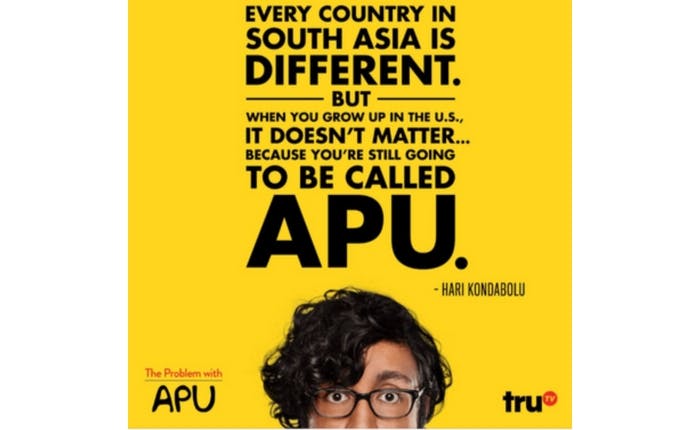
As well, the effects of years of daily race-based bullying were forever etched into my autonomic nervous system. I remember watching The Simpsons with a room full of friends in college and cringing equally the room erupted in laughter at "thanks; come once more!" In that room surrounded by friends, I felt a nagging sense of dread and discomfort that I couldn't quite place, just I knew information technology was related to my cumulative experiences of growing upwardly chocolate-brown among white folks. I felt uneasy, unsafe, and reminded that I didn't fully belong; moreover, I was reminded that to truly belong, I would have to swallow that reaction to Apu and allow it get. Calling it out was never an option.
For periods of my life, pushing down that nagging, nebulous discomfort seemed to work. I married a white human that I loved and started a family; I made white friends who I felt accepted me for who I am and with whom I felt condom, and I moved into a community that, on the surface, felt both various and welcoming of diversity.

The 2016 Ballot validates years of racial trauma
After the election in 2016, when this country elected a president who had run on a platform of racism and hatred, I felt raw and vulnerable in a way that I hadn't felt in years. Even though I lived in a progressive neighborhood and was surrounded by friends who were white allies, all of the memories of all the horrible things people said to me when I was a kid came back to me in a flood that I couldn't stop. The torso remembers, and it remembers vividly and viscerally, even later years (decades) have passed. That discomfort and feeling of always being on alert that had been firmly carved into my neural pathways returned with a vengeance, and I found myself on guard when I walked downwardly the street in my liberal bubble of a neighborhood. I felt no longer able to button down and eat the hurt and, moreover, I finally saw my proximity-to-whiteness strategy for what it was: a response to racial trauma.
During those post-ballot months, I establish myself seeking out folks of color in an unprecedented mode and craved spaces without white folks. I wanted to be effectually people who understood my sense of not feeling safe, people whose neural pathways were activated by the same triggers and who would understand a history that carried pain and shame that I didn't desire to have to explain. I wanted to exist around people who were as well seething with rage and biting their tongues to go on from yelling at white women in yoga tank tops with our cipher code shaped into a Sanskrit Om on their chests. I wanted to be around people who also felt the genu-buckling ire at seeing grown-up versions of the kids who teased us for being brown now eager to commodify, consume, and appropriate our civilization with the latest yoga trend. I wanted to exist in spaces where I didn't feel hypervigilant, where that sense of uneasiness could allay a little. When I did find those spaces and made those connections, I felt like was exhaling afterwards years of holding my breath.
Back in college, while no one pointed at me and said "thank you lot; come again", neither did anyone name the racism that was central to Apu'due south graphic symbol. Both so and at present, while white folks around me both could and continue to ignore racism because it doesn't affect them directly, I am and accept been continuously left wondering for all of these years if I am crazy or over-reacting whenever I accept that visceral reaction to racism. Racist internet memes such as those making plays on "Namaste" fill up me with cocky-doubt to this solar day. If (white) people shut to me don't see the racism in that, am I imagining it? Or am I existence also sensitive? The rational side of me knows that I'm not, but afterwards years without acknowledgment or validation of my reactions, the feeling of doubt is ingrained.
Perchance this is has been the hardest piece of being surrounded by whiteness and flirting with the feeing of prophylactic: just when I call back that I have reached a new level of comfort, I am blind-sided past racism and and then blind-sided again by the gaslighting of white peers. I'm told the comments on a parenting listserv were "well-intentioned", and I was being "as well sensitive" because someone was "pushing a hot button" for me. I'm assured that a so-chosen content expert'south racist remark near an Indian doctor in a course I took was simply "the speaker's perspective". When the white people effectually me have chosen to not admit racism and have dismissed my perception of racism, I doubt myself, and I stop speaking up. I am faced with the choice of staying quiet and swallowing that repeated experience of oppression or speaking up and risking angering and alienating my white peers. Neither choice is fair or appealing, and I find myself spending a great deal of free energy making mental calculations most the pros and cons of speaking upwards vs. staying placidity.
Moving forward: Parenting my biracial brown children
Equally a parent of ii brown kids who are on the verge of adolescence, I oftentimes wonder what advice will resonate with my kids and think dorsum on how my own mother used to always tell me to go talk to whatever Indian girl she saw across the room, as if being Indian was plenty to brand us friends. What did my mom remember I would gain out of those interactions? Did she think we would talk well-nigh the music or Boob tube shows we liked? Or did she think nosotros would see a mirror of our own racialized experience in a peer—that we would talk about the ways our names were mispronounced and how white girls held their noses in our mothers' kitchens? Did she think we would talk about the uneasiness nosotros couldn't quite proper noun just that gnawed at us nevertheless?
Thankfully, my kids do not confront the overt racism that I faced equally a child. That said, I feel an obligation to warn them about the illusion of proximity-to-whiteness as protection from racism, and to encourage them to brand different choices than I did. In our ongoing and future conversations and by case, the gist of what I want to communicate with them about resisting racial oppression is this:
"Make sure you take close friends of color. Racist stuff will happen to y'all, and you will non want to face up it lone. Your white friends will be able to choose whether to see racism and run into your pain, and that will hurt. Your friends of color will be more probable to validate your experiences with racism because they, likewise, have experienced racism. You will demand those people around you so that you don't dubiousness yourself and your own truth. As well, people of color are situated differently from each other, depending on their racial identities and all of the different ways that people can be oppressed. You volition demand to be a good ally by seeking out and showing up for friends and peers of color whose experience of racism is not similar yours and is worse than yours."
I have beloved and pity for the kid I was, who at my kids' historic period, had learned to craft a self and an identity based on fear and a want to survive socially. I wish someone had understood and validated both my fear and my desire to emulate whiteness—and I also wish that I had had the social safety of other options besides blending in or being an outcast. And I wish I had had an understanding of how my own privilege (in the form of access to white spaces) granted me these options while denying them to other folks of color. As I reflect on the layers of what I did not sympathize as a child and adolescent, I promise that I tin offer guidance to my kids then that they can proper name and navigate the many nuanced layers of oppression and privilege.
What if I had gone over and talked to those Indian girls across the room years ago? Would we be best friends now? Probably not, but nosotros might accept connected over our shared experiences. I might have been able to make different choices as brown girl creating space for herself in a white-centered culture if I hadn't faced racism solitary. It took me years to find spaces where I could breathe and speak my truths about racism freely, and I want my kids to grow up with those spaces built into their social scaffolding as early on as possible. I want my kids to have peers who are besides navigating the world as kids of color, who tin can provide that space to breathe, and who can say, "Yeah, I get it."
Divya Kumar
Divya works with new families and brings honesty and a fresh voice to all things parenting. As a author and an "in-person person", she creates community and brings people together with her relentless ability to tell it like it is. She lives in the Jamaica Plain neighborhood of Boston with her hubby and two kids. More about Divya >

Source: https://www.embracerace.org/resources/dear-brown-girl-proximity-to-whiteness-does-not-make-you-white
0 Response to "Racist Comments to Indian People Thank You Come Again"
Post a Comment